

Disclosure: Path Lab Supplies is a participant in the Amazon Services LLC Associates Program. As an Amazon Associate, we earn from qualifying purchases made through links on this page, at no extra cost to you.
A frozen section is only as good as the specimen mount underneath it, and is properly stained. When a chuck doesn’t seat correctly, or a specimen disc doesn’t lock into the cryostat head the way it should, the effects show up downstream — in chatter, in inconsistent section thickness, in tissue that shifts mid-cut. For a Mohs surgeon reading margins in real time, that’s not a minor inconvenience. It’s the difference between a clean read and a re-cut.
Why Compatibility Is the First Point of Failure
Most frozen section troubleshooting guides start with technique: freezing temperature, OCT compound application, blade angle. All of that matters. But none of it can compensate for a specimen disc that doesn’t match your cryostat’s specimen head. If the disc is a fraction of a millimeter off, or the shank doesn’t seat the way the holder expects, every downstream step inherits that error.
Leica, Tanner, IEC, and Avantik cryostats all use slightly different specimen head geometries. A disc engineered for one doesn’t always seat cleanly in another — and “close enough” is where chatter, incomplete freezing contact, and specimen shift during sectioning tend to start.
What Poor Compatibility Actually Costs
- Re-cuts. A specimen that shifts mid-section often means starting over — costly in a procedure where the surgeon is waiting on the read.
- Inconsistent section thickness. A loose or misaligned mount makes it harder to hold a uniform 4–6 micron section across the full specimen.
- Wasted tissue. Re-trimming to compensate for a bad mount uses up margin you may not get back.
- Technician fatigue. Fighting an ill-fitting chuck all day adds friction to work that should be routine.
What to Look For in a Specimen Disc
A well-matched specimen disc should lock into your cryostat’s holder without play, hold a firm bond with OCT compound or your freezing medium of choice, and stay dimensionally stable through repeated freeze cycles. If you’re fighting your mounting hardware more than your tissue, it’s worth checking compatibility before troubleshooting anything else.
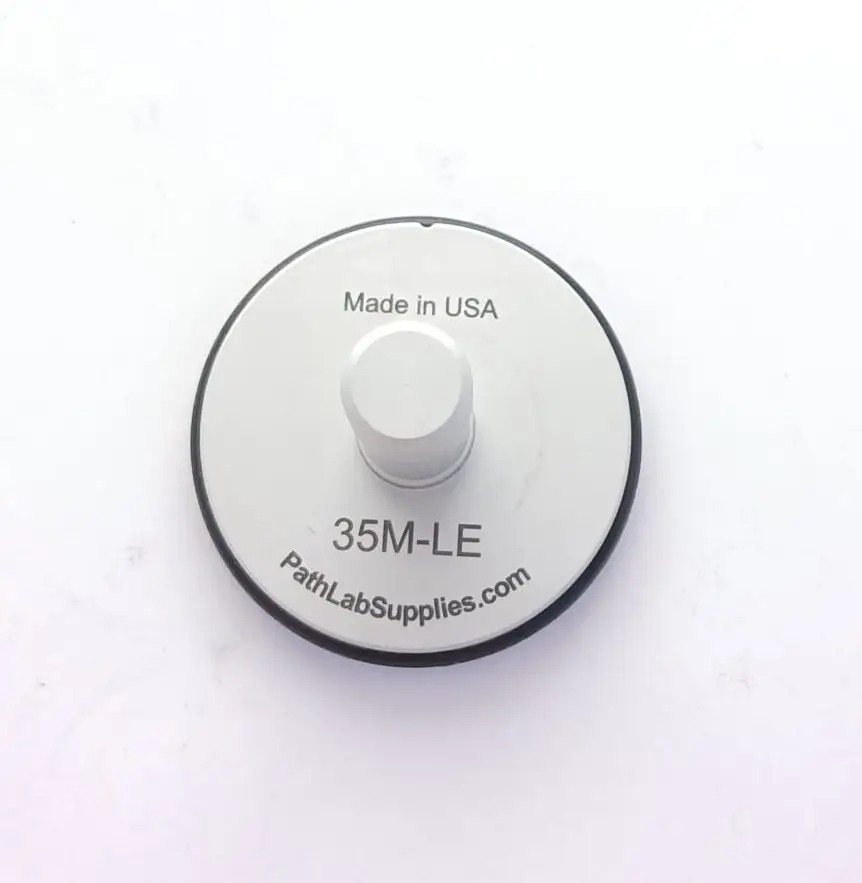
Our specimen discs are built and sized specifically for Leica, Tanner, IEC, and Avantik cryostats — no adapters, no guesswork. Each size is manufactured to seat correctly the first time, so the only variable left to manage is the tissue itself.
Pairing Compatibility With Alignment
Compatibility solves the mounting problem. Alignment solves the next one: getting the specimen positioned so the true margin is captured in the first few sections, not the fifth or sixth. That’s the specific problem the True Margin™ Tissue Press is built to solve, and it’s worth reading about separately if re-cuts and margin misses are a recurring issue in your lab.
The Bottom Line
Frozen section quality starts before the blade ever touches the tissue. A specimen disc that’s actually built for your cryostat — not just “compatible enough” — removes one of the most common, least discussed sources of inconsistency in Mohs labs. It’s a small part with an outsized effect on the read.