

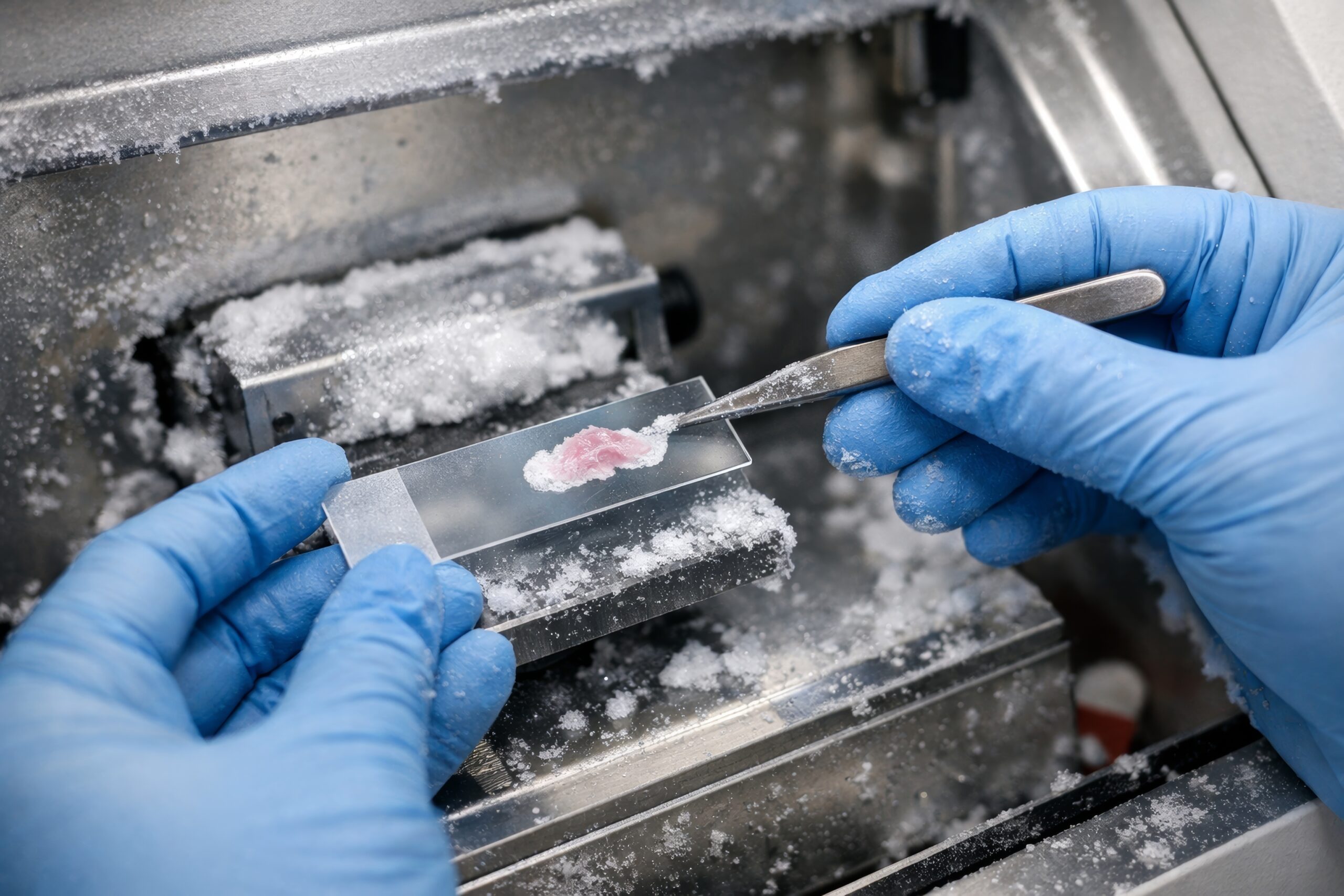
The surgeon reads the margin. But by the time that read happens, a lab technician has already made a dozen decisions that determine whether it’s accurate: how the specimen was mapped, how it was embedded, how the block was sectioned, how it was stained. A skilled Mohs surgeon working from a poorly prepared slide is still working from a poorly prepared slide. Technician competency isn’t a background detail in Mohs surgery — it’s part of the diagnostic chain.
Why This Is Different From General Histology Training
General histotechnology training covers processing, embedding, and staining broadly. Mohs lab work adds a layer most general training doesn’t touch: specimen mapping precise enough that a positive margin on the slide can be traced back to an exact location on the patient, under time pressure, while the surgeon and patient are waiting. That’s a distinct skill set, and it’s why a certification process built specifically for Mohs lab work matters more here than a general lab credential does.
What Goes Into Certifying a Mohs Lab Technician
We follow a structured certification procedure, in partnership with MohsPros Histology, before a technician is considered qualified to support Mohs cases independently. At a high level, it covers:
Eligibility
A high school diploma at minimum, formal training in histotechnology or medical laboratory science (an associate degree or higher preferred), and at least six months of hands-on experience in a dermatology or Mohs lab setting before certification is even on the table.
Formal Training
Candidates go through an approved training program covering the principles of Mohs micrographic surgery, specimen handling and mapping, cryostat operation and tissue sectioning, staining techniques (H&E, toluidine blue), quality control and troubleshooting, and lab safety — all with hands-on practice supervised by a certified Mohs surgeon or senior technician.
Competency Evaluation
This is where training gets tested, not just completed. A written exam covers theoretical knowledge of Mohs histology, safety, and procedure. A practical assessment requires the candidate to actually prepare and stain tissue sections, map and document accurately, and demonstrate cryostat use and troubleshooting — evaluated directly by a certified Mohs surgeon or designated examiner.
Certification and Ongoing Standards
Certification is issued only to candidates who pass both the written and practical components, and it isn’t a one-time credential. Certified technicians complete continuing education every two years and must demonstrate ongoing competency to maintain certification — not just repeat what they knew when they started.
Why This Should Matter to a Surgeon Choosing a Lab Partner
When you’re evaluating a lab or a histotechnology partner, technician certification is one of the few things you can actually verify before a case, rather than finding out after a margin call goes wrong. It’s a reasonable question to ask directly: what does your lab’s certification process actually require, and who signs off on it?
You can read our full certification procedure directly — the complete document is posted here. It’s also worth a look at how we structure our lab services more broadly if you’re evaluating histotechnology support for your practice.
The Bottom Line
Equipment and technique get most of the attention in conversations about frozen section quality. The technician preparing the slide deserves at least as much. A structured, verifiable certification process — not just on-the-job experience — is what makes lab quality something you can trust rather than something you hope for.